English
 Español
 عربى
عربى हिंदी
हिंदी
Nylon DTY vs Nylon FDY: Properties, Applications & How to Choose
Content
- 1 What Makes Nylon Yarn Different from Polyester
- 2 Nylon FDY: Structure, Properties, and Where It Performs Best
- 3 Nylon DTY: Structure, Properties, and Where It Performs Best
- 4 Nylon DTY vs Nylon FDY: A Side-by-Side Comparison
- 5 How to Choose the Right Yarn for Your Application
- 6 What to Look for in a Nylon DTY and FDY Supplier
Nylon filament yarn comes in dozens of configurations, but two types sit at the center of most sourcing decisions: FDY and DTY. Each starts from the same raw material—Nylon 6 chips—yet the manufacturing path diverges sharply, and so do the results. A fabric designed for yoga wear and one engineered for smooth warp-knit linings require fundamentally different yarns. Getting that choice wrong means rework, waste, and delayed shipments. Getting it right means a stable supply of material that performs exactly as the end product demands.
This guide breaks down Nylon DTY and Nylon FDY from the ground up—production logic, performance characteristics, application fit, and how to evaluate a supplier capable of delivering both at consistent quality.
What Makes Nylon Yarn Different from Polyester
Before comparing DTY and FDY, it helps to understand what the base material—Nylon 6—brings to the table that polyester does not. The distinction matters because the same yarn type (say, DTY) behaves differently depending on whether it is spun from polyamide or polyester.
Nylon 6, produced from caprolactam via ring-opening polymerization, yields fibers with higher tensile strength, superior abrasion resistance, and better moisture management than standard polyester equivalents at the same denier. It also dyes at lower temperatures and with better depth of shade, making it the preferred choice for apparel categories where color consistency and skin contact comfort are non-negotiable. The trade-off is cost: nylon chips command a premium over PET chips, and that premium flows through every downstream yarn type.
For manufacturers sourcing nylon 6 chips that form the foundation of filament production, the chip quality—viscosity consistency, moisture content, polymerization uniformity—directly determines the spinning stability of every FDY and DTY batch that follows.
Nylon FDY: Structure, Properties, and Where It Performs Best
FDY, or Fully Drawn Yarn, is produced in a single continuous spin-draw process. The polymer melt is extruded through spinnerets, the filaments are cooled, and they are then drawn—stretched—to their final molecular orientation in one integrated step. There is no intermediate winding stage. The result is a yarn that arrives at the knitting or weaving machine fully oriented, dimensionally stable, and ready for direct use.
The defining characteristics of Nylon FDY follow directly from this process:
- Smooth, uniform surface. Because the filaments are not texturized, FDY presents a clean, flat profile. Fabrics made from it have a natural luster—not the artificial sheen of a coating, but the inherent sheen of well-oriented nylon filaments.
- High tensile strength. Full molecular orientation means maximum fiber strength. FDY excels in applications where load-bearing or abrasion resistance is a functional requirement, not just a nice-to-have.
- Low elongation and elasticity. FDY holds its shape. This is an advantage in structured weave constructions but a limitation wherever stretch and recovery are needed.
- Excellent dyeability. The uniform structure allows consistent dye uptake, which translates to even color across fabric lots.
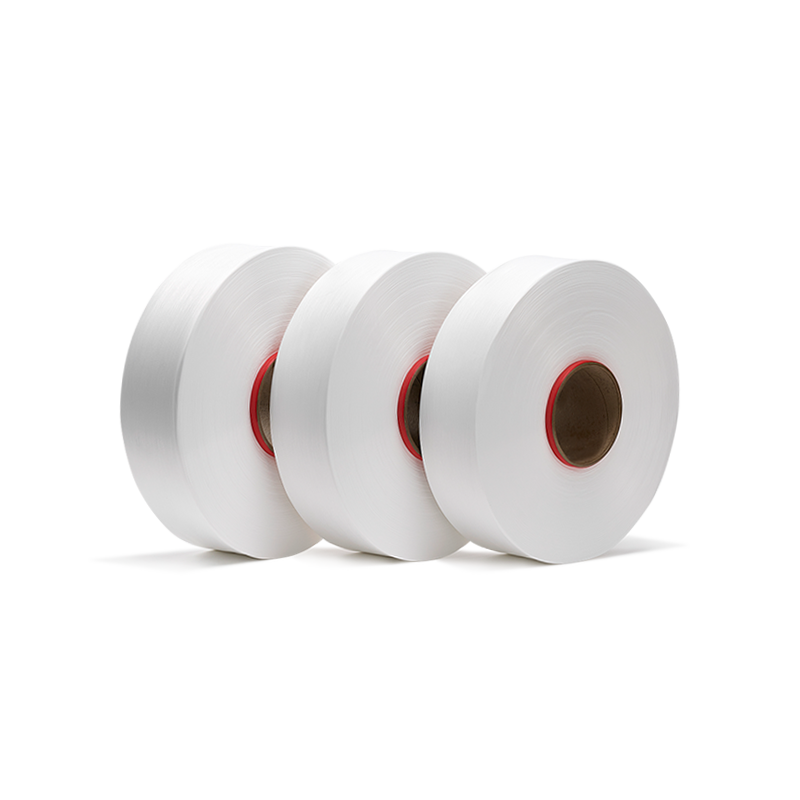
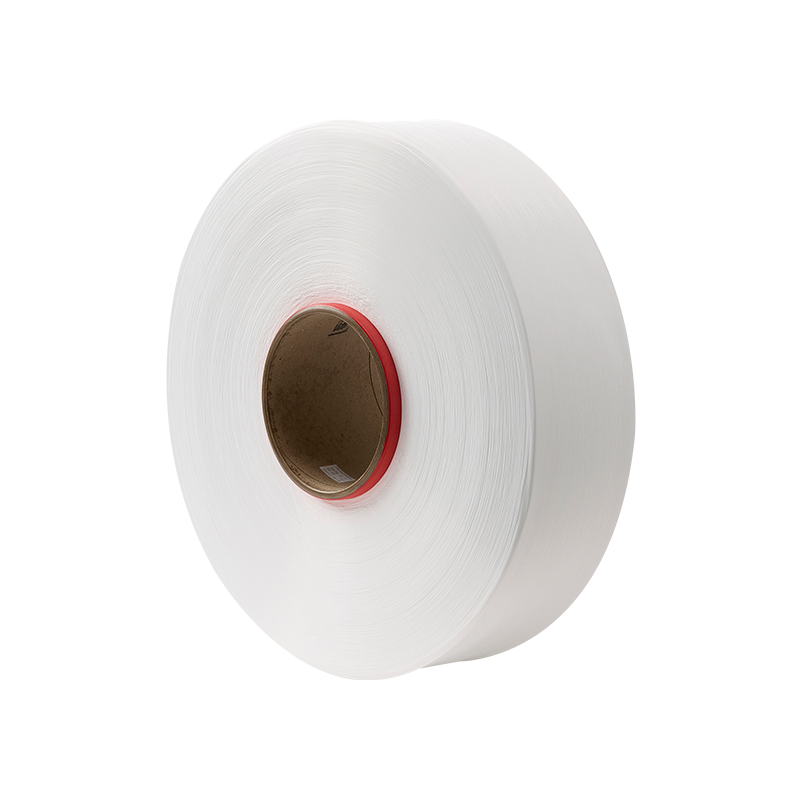
In application terms, smooth nylon filament yarn for weaving and warp knitting dominates in categories including woven sportswear liners, hosiery base fabrics, high-end apparel linings, embroidery threads, and narrow woven tapes. Anywhere a clean surface, stable construction, and strong filament integrity are required, FDY is the logical starting point.
Typical denier ranges for Nylon FDY run from ultra-fine (10D) up to 140D, with filament counts adjusted to control surface finish and hand feel. Finer deniers (10D–30D) are common in hosiery; mid-range (40D–70D) dominates woven sportswear and linings; heavier deniers serve technical and industrial textile applications.
Nylon DTY: Structure, Properties, and Where It Performs Best
DTY, or Draw Textured Yarn, takes a different route. It starts from Partially Oriented Yarn (POY)—an intermediate product that still retains stretching potential—and runs it through a texturizing machine where simultaneous drawing and false-twisting introduce crimps, loops, and coils into the filament structure. The yarn that exits this process is fundamentally transformed: it has bulk, it has stretch, and it has a tactile softness that no FDY can replicate.
The performance signature of Nylon DTY centers on three properties:
- Elasticity and stretch recovery. The crimped filament structure acts like a spring—the fabric stretches under load and returns to its original dimensions. This makes DTY the foundation of every garment category where freedom of movement is the core value proposition.
- Bulk and soft hand feel. The interlocked loops and crimps create air pockets within the yarn, giving fabrics a fuller, warmer, and softer feel than equivalent FDY constructions.
- Versatility in knit constructions. DTY works well across circular knitting, warp knitting, and tricot machines. Its elastic behavior accommodates the loop-forming mechanics of knitting far more naturally than the stiffer FDY.
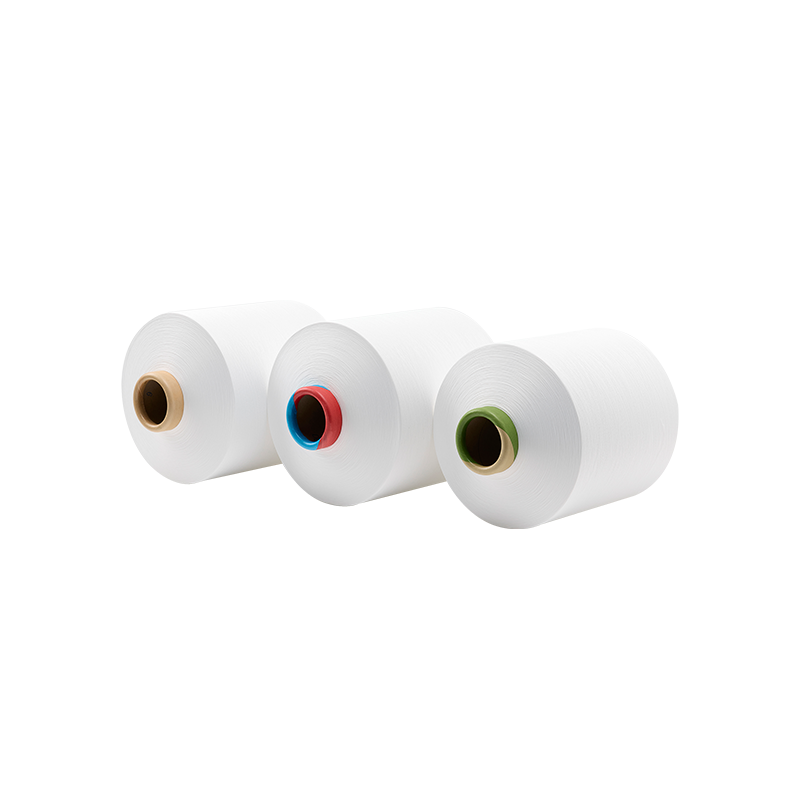
Application categories for draw-textured nylon filament in denier ranges from 8D to 140D include yoga and activewear fabrics, children's clothing, hosiery, swimwear blends, and intimate apparel. The denier range here is wide—8D ultra-fine for delicate hosiery all the way to 140D for performance outerwear knits—with filament counts from 5F to 136F allowing manufacturers to fine-tune surface texture and opacity.
DTY is also available in three luster variants—full dull, semi-dull, and bright—each suited to different aesthetic requirements. Full dull gives a matte, cotton-adjacent look preferred in children's and athleisure categories; bright variants carry a higher sheen for swimwear and fashion fabrics.
Nylon DTY vs Nylon FDY: A Side-by-Side Comparison
Choosing between FDY and DTY often comes down to one pivotal question: does the end fabric need to hold its structure, or does it need to move with the body? The table below maps the key differences across the decision criteria that matter most to textile manufacturers.
| Criteria | Nylon FDY | Nylon DTY |
|---|---|---|
| Production Process | Single-step spin-draw; no texturizing | POY → false-twist texturizing; two-stage |
| Filament Structure | Straight, smooth, fully oriented | Crimped, looped, bulky |
| Elasticity | Low; dimensionally stable | High; excellent stretch and recovery |
| Surface Texture | Smooth, lustrous | Soft, bulky, matte to semi-bright |
| Tensile Strength | Higher | Moderate (sufficient for apparel) |
| Fabric Construction | Weaving, warp knitting, embroidery | Circular knitting, warp knitting, tricot |
| Typical Applications | Linings, hosiery, sportswear shells, tapes | Yoga wear, underwear, children's clothing, swimwear |
| Relative Cost | Lower (fewer processing steps) | Higher (additional texturizing stage) |
Neither yarn type is universally superior. FDY costs less per kilogram at equivalent denier because it skips the texturizing stage. But DTY delivers properties—elasticity, softness, bulk—that FDY cannot replicate, and those properties command a price premium in the end market. The cost difference is rarely the deciding factor; the end-use requirement is.
How to Choose the Right Yarn for Your Application
Three questions clarify the decision in most cases:
1. What is the fabric construction? Woven fabrics—where yarns interlace at right angles under tension—benefit from FDY's dimensional stability. The yarn needs to hold its position in the weave without excessive elongation. Knit fabrics, which form interlocking loops, work better with DTY's elastic character. The loop structure of knits naturally accommodates stretch; a stiff yarn in a knit construction creates a boardy, uncomfortable hand feel.
2. What does the end product demand from the fabric? A compression sports short needs recovery. A structured jacket lining needs smoothness and durability. A children's legging needs both softness and wash durability. Mapping the functional spec of the end product to yarn properties eliminates most ambiguity.
3. What is the desired surface aesthetic? If the finished fabric should have a crisp, smooth, slightly lustrous surface—FDY. If it should feel soft, look matte or naturally textured, and drape with some body—DTY. For certain hybrid constructions (elastane-core, covered yarns), neither plain FDY nor DTY is the final answer; air-covered nylon yarns for elastane-core applications combine a nylon shell with a spandex core for simultaneous smoothness and high stretch.
When these three questions are answered, the specification narrows further to denier, filament count, and luster finish—decisions that depend on the specific machinery in use and the target fabric weight.
What to Look for in a Nylon DTY and FDY Supplier
Yarn specification is only half the sourcing equation. A supplier who can produce the right yarn but cannot maintain batch-to-batch consistency, meet lead times, or scale with demand introduces supply risk that no price advantage can offset.
The most reliable Nylon DTY and FDY suppliers share a common set of characteristics. First, they control the full production chain—from chip polymerization through spinning. Suppliers who purchase POY or chips from third parties have less leverage over quality variables at the raw material stage. Suppliers with in-house chip production can control viscosity, moisture content, and additives before the filament ever reaches the spinning line.
Second, equipment matters. Texturizing equipment from established manufacturers—German Barmag systems for DTY, Japanese TMT winding lines for FDY and POY—produces more consistent tension profiles, better crimp uniformity, and fewer defects than entry-level alternatives. These are not marketing claims; they translate directly to fewer yarn breaks on the customer's knitting or weaving machine.
Third, certification provides a baseline of process discipline. ISO 9001 for quality management, ISO 14001 for environmental management, and GRS (Global Recycled Standard) certification are increasingly demanded by international brands as proof of supply chain traceability. They also signal that the supplier has documented processes and measurable quality targets rather than relying on operator judgment alone.
Zhejiang Fangyuan New Material Co., Ltd. operates from a 135,000 m² production base in Tongxiang, Zhejiang, with annual capacity of 300,000 tons. The company's product line spans the full nylon filament range—POY, HOY, smooth nylon filament yarn for weaving and warp knitting, and draw-textured nylon filament in denier ranges from 8D to 140D—backed by in-house Nylon 6 chip polymerization that gives Fangyuan direct control from raw material to finished yarn. With ISO 9001, ISO 14001, ISO 45001, and GRS certifications in place, and production equipped with Barmag texturing and TMT winding systems, the facility is structured to supply downstream textile manufacturers at both the scale and consistency that global apparel sourcing demands.