English
 Español
 عربى
عربى हिंदी
हिंदी
Nylon DTY Yarn: Properties, Production, Applications, and Supplier Selection
Content
Ask a production manager who runs stretch fabrics why nylon DTY keeps appearing on the order list, and the answer usually comes down to consistency as much as comfort. DTY is not one fixed product; it is a family of draw-textured yarns whose final behavior depends on the feed yarn, the texturing process, and the quality checks in between. Getting those details right matters more than comparing price per kilogram alone.
What Is Nylon DTY Yarn?
DTY stands for draw textured yarn. In the polyamide 6 segment, nylon DTY is made by taking partially oriented yarn, drawing it, and texturing it to create crimp, bulk, and elasticity. The texturing step transforms a relatively straight filament into a spring-like structure that gives fabric stretch recovery and a fuller hand feel. That is why DTY differs from flat yarns such as FDY: it behaves less like a smooth filament and more like a micro-spring.
DTY belongs to the textured yarn family. Texturing changes a flat multifilament yarn into one with waviness, loops, or crimp. In nylon DTY, the most common process is false-twist texturing, which produces a stretchy, bulky yarn that can be knitted and woven with good cover. The term DTY is also used in the polyester industry, so always confirm that you are ordering nylon 6 DTY and not a polyester DTY with different melting, dyeing, and shrinkage behavior.
Buyers usually evaluate DTY by denier, filament count, elongation, and dye take-up. A common range for apparel-grade nylon 6 DTY is 20D to 200D, with higher deniers used for socks, cords, and industrial fabrics. When you need a material reference for planning, the nylon draw textured yarn product page lists the grade options and helps you talk to the supplier with a common set of terms.
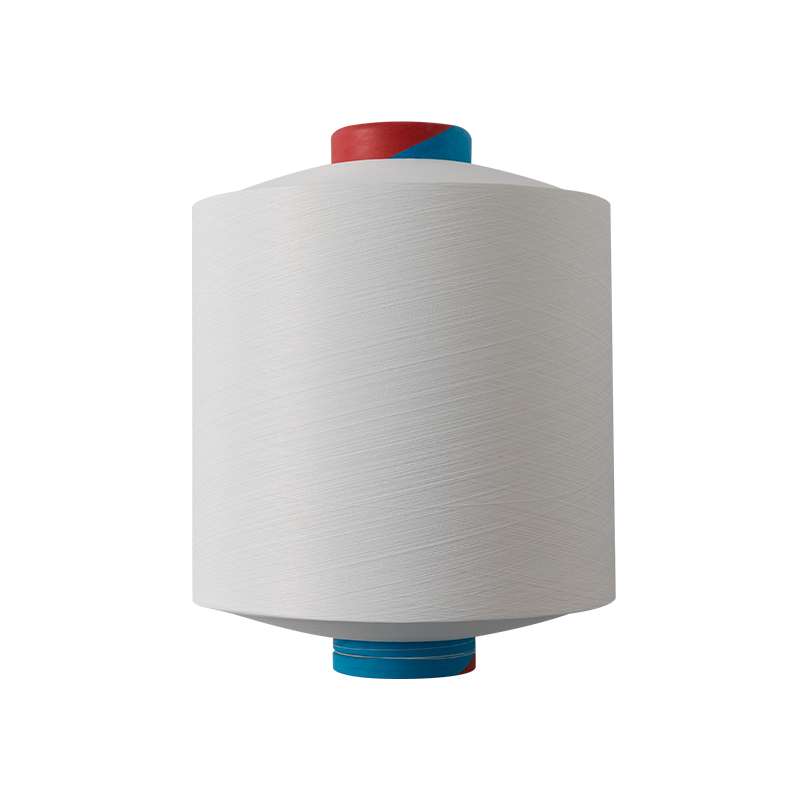 Nylon 6 DTY Yarn Manufacturer, Nylon 6 Draw Textured Yarn SupplierAs Nylon 6 DTY Yarn Manufacturers and Nylon 6 Draw Textured Yarn Suppliers, China Nylon 6 DTY Factory Direct, Fangyuan Supply Bulk Nylon ...View Product →
How Nylon DTY Is Made
Nylon DTY production starts at the extrusion line. Polymer chips are melted, extruded through spinnerets, and drawn into filaments that are wound into POY at high speed. POY is partially oriented: the molecular chains are aligned, but the yarn has not been drawn enough for most final uses. The DTY process takes that POY through a texturing machine with heated rollers, a false-twist unit, a second heater, and a cooling zone.
During false-twist texturing, the yarn is twisted, heated, set, and untwisted. The heat sets the crimp while the twist allows the filaments to deform, producing a yarn with zig-zag crimp and springiness. Draw ratio, texturing temperature, and twist settings determine the final crimp and shrinkage. If the POY has even small denier variation, texturing amplifies it into a visible dye or stretch problem. A supplier with its own nylon partially oriented yarn line can monitor tenacity and denier before texturing starts, which matters when you need tight batch control.
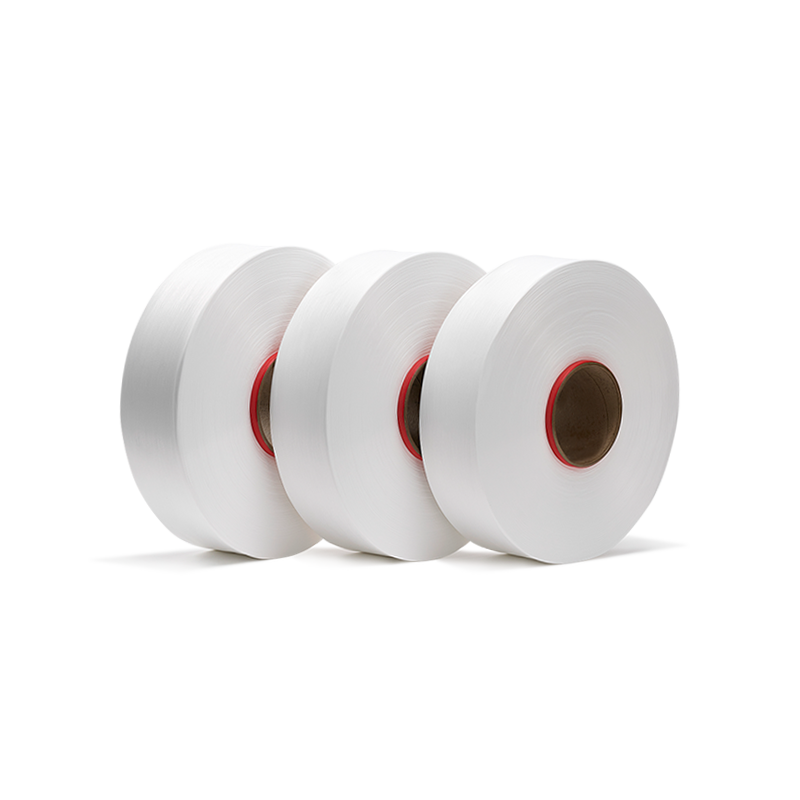 Nylon 6 POY Yarn, Nylon 6 Partially Oriented Yarn ManufacturerAs China Nylon 6 POY Yarn Manufacturers and Nylon 6 Partially Oriented Yarn Suppliers, Fangyuan offer Bulk Nylon 6 POY Wholesale, Nylon 6...View Product →
Temperature control is critical throughout the process. If the cooling zone is too short, the crimp is not set properly. If the heater is too hot, the yarn becomes brittle and dye uptake changes. That is why DTY quality is measured not only by strength, but also by crimp stability and dyeability.
Key Properties That Matter in Production
Nylon DTY is chosen not because it is the strongest yarn on the market, but because it balances elasticity, bulk, and abrasion resistance. The same yarn can feed a knitting machine for seamless underwear or a rope twister, if the properties are specified correctly.
A typical apparel-grade nylon 6 DTY has a tenacity of 4 to 6 cN/dtex and an elongation at break of 25% to 40%, but these figures shift for high-elasticity and industrial versions. Instead of memorizing numbers, focus on tolerances. A supplier that quotes a wide elongation range may produce yarn that works today and breaks tomorrow.
| Property | Why it matters | What to verify |
|---|---|---|
| Tenacity | Determines strength in ropes, cords, and industrial fabric | Consistent breaking strength across production lots |
| Elongation | Controls stretch and behavior on the knitting line | Elongation at break and variation within the delivery |
| Crimp and bulk | Gives fabric cover and a fuller hand feel | Crimp contraction or curl values from the supplier |
| Shrinkage | Affects final garment size and shape stability | Dry heat and hot-water shrinkage test results |
| Dye take-up | Determines whether different lots produce the same shade | Sample dye test from start, middle, and end of a run |
| Oil finish | Affects unwinding, knitting, and weaving performance | Oil content and compatibility with your machinery |
These properties are linked. A yarn with high crimp may have lower tenacity. A yarn with very low shrinkage may need different dyeing conditions. The best specification is the one matched to your process, not the most impressive number on a datasheet.
Nylon DTY vs. FDY vs. POY
DTY is often compared with FDY because both are everyday nylon yarns, but they behave differently. FDY is fully drawn, flat, and has low stretch. DTY is textured, bulkier, and more elastic. POY is the intermediate form and is normally texturized before use in apparel. The choice changes fabric hand, stretch, cost, and downstream processing.
Seamless underwear brands often pick DTY because crimp improves shape recovery and fabric density. Woven labels and linings may use flat FDY for sharpness and smoothness. For many factories, the decision starts with the end use. A sock manufacturer needs bulk and stretch, so DTY is natural. A flag fabric producer needs a flat, stable surface, so FDY makes more sense. Our nylon DTY vs. FDY comparison explains the property differences and how to match them to your product.
Common Applications of Nylon DTY
Because nylon DTY combines elasticity, bulk, and wear resistance, it appears in products that need to move with the body or survive repeated bending.
- Activewear and sportswear: stretch and recovery keep the garment in shape during movement.
- Hosiery and socks: DTY gives softness, elasticity, and even dyeing.
- Seamless underwear: crimp improves coverage and shape retention.
- Ribbons, cords, and braided elastics: abrasion resistance extends product life.
- Industrial textiles: ropes, filter cloths, and woven industrial fabrics benefit from strength and consistent thickness.
Nylon DTY is also used in narrow fabrics and woven elastics where repeated stretch is important. In these applications, a small difference in crimp or shrinkage can change the final width of the product, so consistency from one delivery to the next is essential.
Purchasing Nylon DTY: What to Verify Before You Commit
Price per kilogram is easy to compare; total production cost is not. A low-priced DTY that creates breaks, shade differences, or excessive shrinkage becomes expensive once it reaches your knitting machines. Before placing an order, ask about the following points.
- Raw material traceability: does the producer control its own polymer and POY, or does it buy undifferentiated POY on the spot market?
- Denier and elongation range: confirm that the listed spec matches the lot you are actually buying.
- Batch-to-batch dye consistency: ask for a dye lot or a sample test from two different production dates.
- Package condition: inspect for damaged edges, inconsistent winding, or variable package density.
- Oil finish compatibility: check that the finish works with your knitting, weaving, and downstream setting conditions.
- Supply lead time: repeat orders depend on delivery windows, not just one-time availability.
Rather than asking for the cheapest yarn, ask for the tolerances. A responsible supplier will tell you the expected range and how they test it. This is where a buyer with previous experience can shorten the negotiation cycle: the supplier knows that you will check the yarn, and you know that the supplier will respect the specification.
Polymer control is easier to verify when the supplier starts with chips instead of buying yarn on the open market. That is why many mills ask whether the plant produces its own nylon 6 chips; it removes one source of variation and gives the DTY supplier responsibility for the raw material as well as the finished yarn.
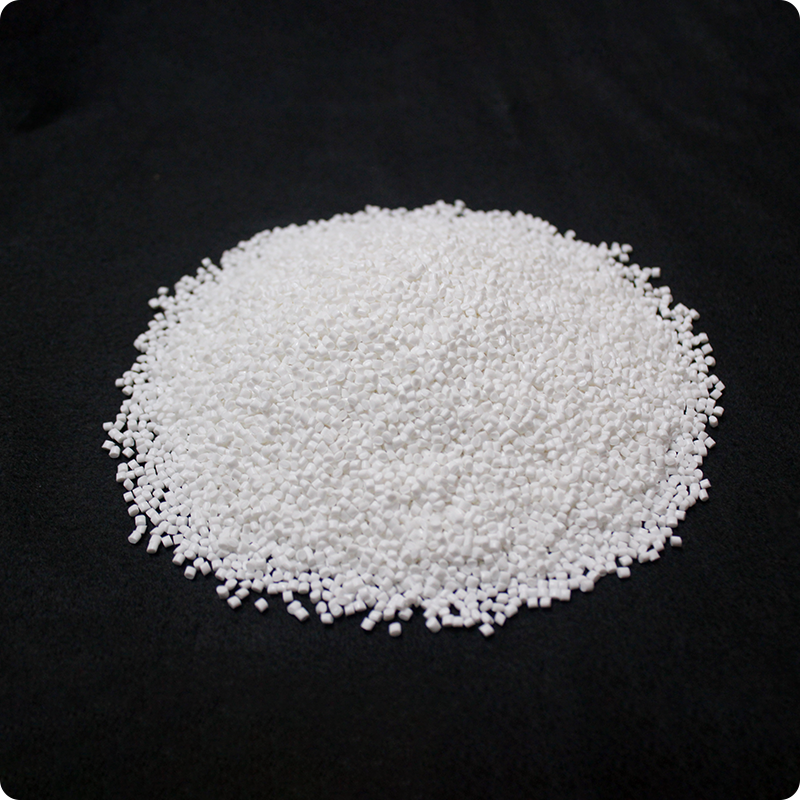 China Nylon 6 Chips Supplier, Wholesale Nylon 6 Chips FactoryAs Fiber-grade Nylon 6 Chips Suppliers, Film-grade Nylon 6 Chips Factory and Engineering-grade Nylon 6 Chips Suppliers, Fangyuan offer Ny...View Product →
Choosing nylon DTY is ultimately a process decision. Define the properties you need, verify samples under the same conditions you use in your factory, and check the supplier's production depth rather than relying on a single datasheet. A reliable DTY source is the one that delivers the same yarn next month and next year, with the same stretch, the same shade, and the same winding quality.