English
 Español
 عربى
عربى हिंदी
हिंदी
Texturing in Textile Production: Methods, Yarn Types and Process Control
Content
- 1 What Texturing in Textile Manufacturing Actually Does
- 2 The Main Texturing Methods Used in Yarn Mills
- 3 Reading Yarn Designations: POY, HOY, FDY, DTY and ACY
- 4 How Texturing Changes Fabric Performance
- 5 Process Control: Where Textured Yarn Goes Wrong
- 6 Choosing a Nylon Textured Yarn Supplier
- 7 Frequently Asked Questions About Texturing in Textile Production
Two fabrics can leave the same mill with identical construction, identical yarn count and an identical dye recipe, and still behave like two different materials on the cutting table. One feels dense, flat and slightly glassy; the other has loft, warmth and a springy recovery when it is stretched. In most cases the difference traces back to one upstream decision: whether the filament yarn was textured, and which texturing route the spinner used.
What Texturing in Textile Manufacturing Actually Does
Texturing is the step that turns a smooth, continuous filament into a yarn that behaves like spun fibre. A flat nylon 6 filament is dense, cylindrical and reflective: it packs tightly, feels cool and slippery, and traps very little air. Texturing breaks that uniformity on purpose, and the change is permanent.
The mechanism is easiest to see in false twist. The yarn is twisted, heated so the twist is locked into the filament structure, then untwisted. Untwisting does not undo the deformation; it travels back along the yarn and leaves every filament with a helical memory. That memory is why a textured yarn opens up when relaxed and springs back when stretched.
- Dense packing and a closed surface
- High lustre and a cool, slippery hand
- Very little stretch or recovery
- Bulk, trapped air and better cover
- Matte surface and a softer, warmer hand
- Elastic recovery and higher dye uptake
For anyone specifying fabric, the practical summary is short: texturing adds volume, softness and stretch, and takes away lustre and dimensional calm. Neither direction is better on its own, but the choice has to be made before the yarn is ordered, not after the fabric is knitted.
The Main Texturing Methods Used in Yarn Mills
Five routes cover almost all commercial texturing: false twist, draw texturing, air texturing, stuffer box crimping and knit-de-knit.
| Method | Working principle | Typical output | Main strength |
| False twist | Twist, heat-set, untwist in one continuous pass | Draw textured yarn | Uniform crimp and high stretch |
| Draw texturing | Drawing and false twist combined on one line | Draw textured yarn | Lower conversion cost |
| Air texturing | Compressed air jet creates loops and tangle points | Air textured and air covered yarn | Stable bulk with low stretch |
| Stuffer box | Yarn compressed into a heated chamber and creased | Crimped tow and yarn | Very high bulk at low cost |
| Knit-de-knit | Fabric knitted, heat-set, then unravelled | Specialty crimped yarn | Distinct intermittent crimp |
False twist and draw texturing
False twist carries the largest share of apparel yarn. A modern line runs the yarn through a contact heater, applies a twist ratio that sets crimp tightness, cools the yarn and then releases the twist at the spindle. Heater temperature, twist ratio and cooling length are the three settings that decide whether the finished yarn crimps evenly. Draw texturing folds the drawing step into the same pass, which cuts conversion cost but narrows the operating window, because orientation and texturing are happening at the same moment.
Air texturing: bulk without stretch
Air texturing uses a compressed air jet to tangle and loop filaments instead of twisting them. The result is bulky and dimensionally steady but has little stretch, which suits upholstery, narrow fabrics and industrial textiles. The same jet principle wraps an elastic core with a nylon cover, which is how air covered yarn is produced.
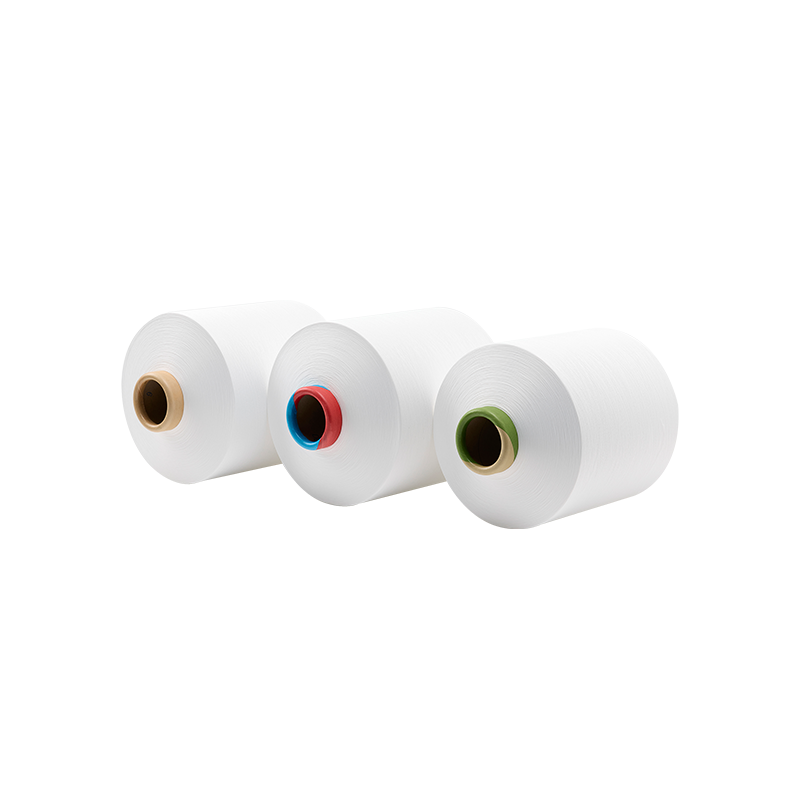
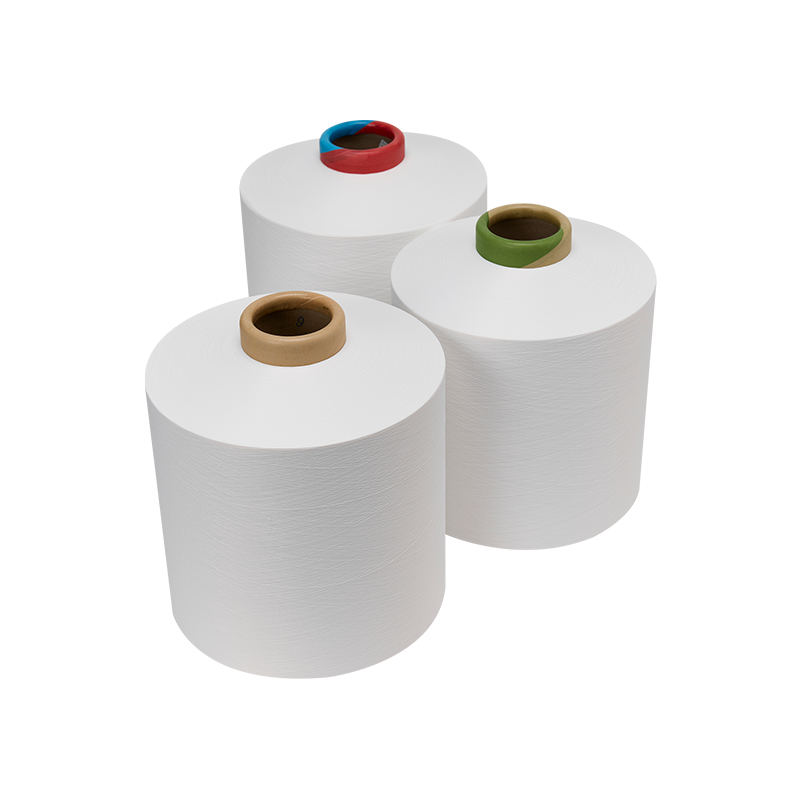 Nylon Air Covered Yarn● High elasticity and resilienceView Product →
Reading Yarn Designations: POY, HOY, FDY, DTY and ACY
The letters on a yarn label describe how far the filament has been processed, and only the DTY family is fully textured.
| Designation | What it is | Textured | Typical use |
| POY | Partially oriented yarn wound as a semi-finished feed | No | Feedstock for draw texturing |
| HOY | High oriented yarn with orientation from the spin line | No | Direct warping, smooth fabrics |
| FDY | Fully drawn yarn, ready for weaving or knitting | No | Linings, uniforms, flags |
| DTY | Draw textured yarn, false twist applied after drawing | Yes | Knitwear, hosiery, sportswear |
| ACY | Air covered yarn, jet-wrapped around an elastic core | Yes, looped | Stretch panels, waistbands |
DTY carries most of the texturing volume, and it is also the specification that punishes inconsistency hardest. Two packages of 70D/24F DTY from different lots can crimp differently, carry different oil pick-up and unwind at different tension, and a high-speed knitter will show all of it as barré, tight spots or needle lines.
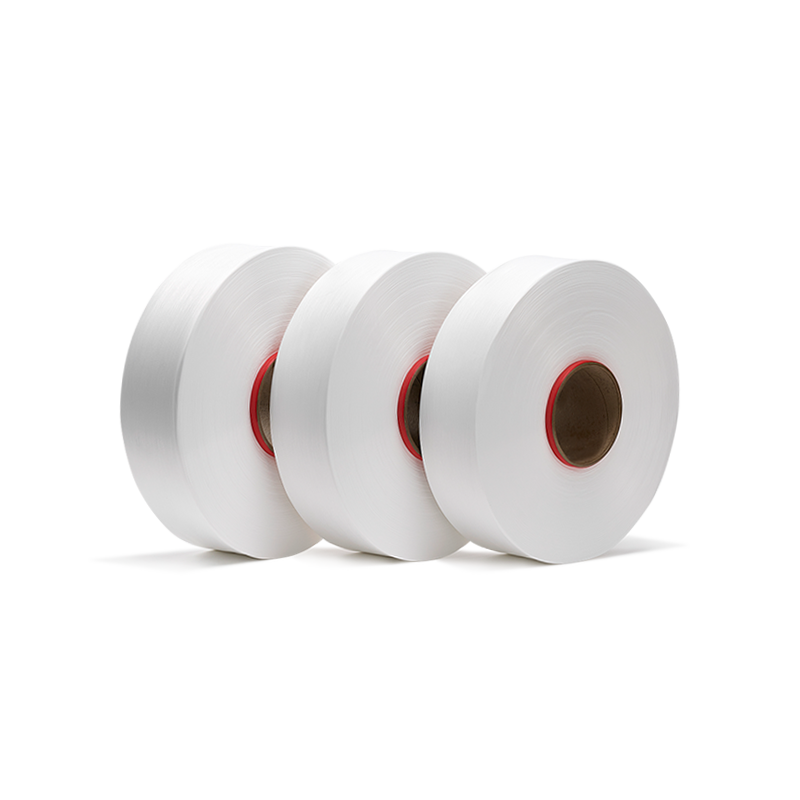
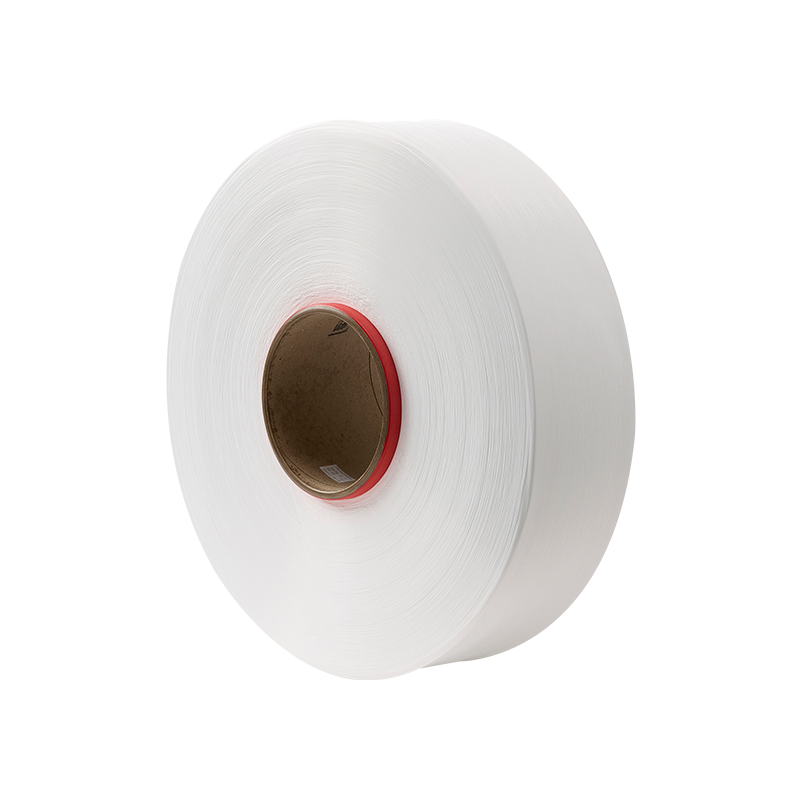
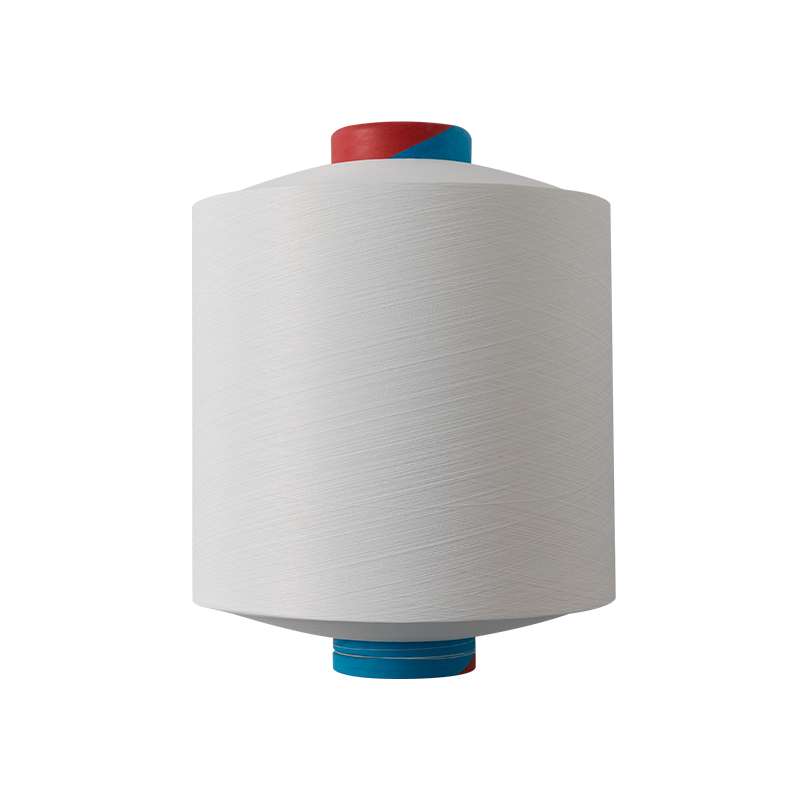 Nylon Draw Textured Yarn● Excellent elasticityView Product →
Air covered yarn belongs to a different family. Instead of twisting the filament, an air jet wraps it around an elastic core, so the fabric takes stretch from the core and hand feel from the nylon cover.
Matching the yarn to the process matters more than matching the price per kilogram. A mill weighing textured yarn against fully drawn yarn for the same garment is really choosing between stretch and dimensional stability, and the comparison of nylon DTY and FDY properties is where that decision usually starts.
How Texturing Changes Fabric Performance
Texturing changes five fabric properties at the same time: bulk, cover, stretch recovery, thermal insulation and surface lustre.
Process Control: Where Textured Yarn Goes Wrong
Most texturing defects trace back to five control points: feed tension, heater temperature, twist setting, cooling and finish application, and winding tension.
- Feed tension. Small drifts between packages show up as crimp variation, and even a narrow margin is enough to create visible barré in a plain knit.
- Heater temperature. Too low leaves the crimp unstable; too high embrittles the filament and produces broken filaments and fuzz.
- Twist setting. The twist ratio sets crimp tightness and stretch; changing it mid-lot makes two packages behave like two different yarns.
- Cooling and finish. The yarn must be cooled before the spindle releases the twist, and oil pick-up controls friction and static downstream.
- Winding tension. Package build decides how the yarn unwinds, and soft and hard packages draw very differently on the same machine.
Defects rarely announce themselves as texturing problems. They surface later in the knitting or weaving room as:
- Barré bands and shading differences across a panel
- Tight spots and thick-thin sections in the yarn path
- Broken filaments and needle lines on fine gauge machines
- Uneven dye uptake between lots of the same shade
- Snarling and tension spikes during unwinding
Choosing a Nylon Textured Yarn Supplier
A textured yarn supplier is judged on three things: substrate consistency, crimp control and delivery reliability, in that order.
- Substrate consistency. Fully dull, semi-dull and bright chip grades dye and reflect light differently, so the polymer behind the yarn has to stay stable lot to lot.
- Lot documentation. Denier, filament count, crimp, oil pick-up and coefficient of variation should travel with every package, not only with the certificate of analysis.
- Trial winding. Production-scale samples on your own machine reveal unwinding and crimp behaviour that laboratory samples never show.
- Technical support. A supplier who can discuss twist ratios and heater settings for your machinery is worth more than a small price advantage.
- Delivery behaviour. Package build, palletising and lead time decide whether the line keeps running next quarter.
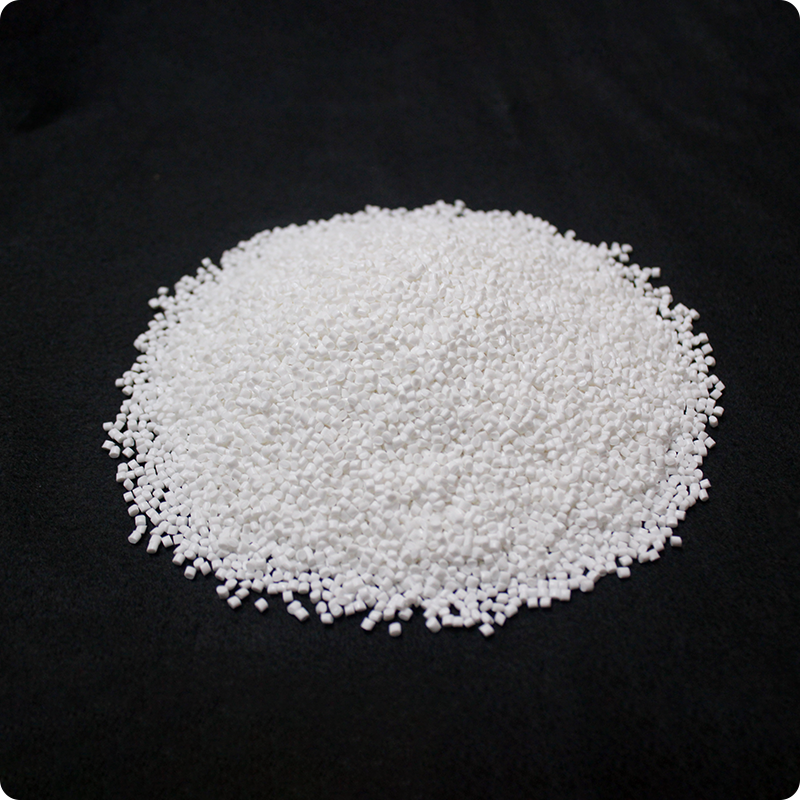 Nylon 6 ChipsNylon Partially Oriented YarnView Product →
Frequently Asked Questions About Texturing in Textile Production
What is the difference between texturing and drawing?
Drawing stretches the filament to align its polymer chains and raise strength; texturing deforms the filament to add crimp, bulk and stretch. Drawing changes the internal structure, texturing changes the geometry of the yarn, and in draw texturing both happen in one pass.
Does texturing weaken nylon yarn?
Tensile strength drops slightly because the filament path is no longer straight, while elongation rises. In practice, most strength loss reported by mills comes from overheating, excessive tension or a worn spindle rather than from texturing itself.
Which texturing method is best for stretch fabrics?
False twist and draw texturing deliver the highest stretch and recovery and dominate apparel. Air texturing suits garments that need bulk and stability but not stretch, which is why it is common in upholstery and industrial fabrics.
Can textured yarn be dyed and finished normally?
Yes, but textured yarn takes up dye faster than flat filament because of its larger surface area and higher bulk. That is also why lot-to-lot crimp variation often appears first as a shade difference rather than as a physical defect.
Texturing sits upstream of almost every property a buyer will judge later, from the warmth of a knit to the recovery of a waistband. It is a mechanical process with a chemical memory, and the mills that control it tightly tend to be the ones that never see a barré claim. Treat the yarn specification as part of the fabric design, and the rest of the production chain becomes considerably quieter.