English
 Español
 عربى
عربى हिंदी
हिंदी
Textile Weaves Explained: Types, Fabric Properties, and Yarn Selection
Content
Run the same 70-denier nylon 6 yarn through two looms—one threaded for plain weave, one for twill—and you get two fabrics that behave differently in cutting, sewing, and wear. The yarn is identical; the interlacing pattern is not. That pattern is what the textile industry means by weave: the fixed sequence in which lengthwise warp yarns and crosswise weft yarns pass over and under each other on the loom.
Nearly every woven fabric on the market is built on three fundamental weaves: plain, twill, and satin. The weave sets the boundaries for durability, drape, and sheen; the yarn you feed the loom decides whether the finished fabric actually reaches those boundaries consistently, batch after batch.
The Three Fundamental Textile Weaves
Every weave is defined by its repeat: the smallest block of over-and-under interlacings that repeats across the cloth. Change the repeat and you change the fabric. The three structures below cover the overwhelming majority of woven goods, and everything else builds on them.
Warp and weft alternate at every intersection
Interlacing points step sideways and form diagonals
Long surface floats with rare, staggered intersections
In each diagram, dark cells mark where the warp yarn lies on the fabric surface; light cells mark where the weft covers it.
Plain Weave
Plain weave is the simplest repeat: each warp yarn passes over one weft and under the next, alternating on every row. Because warp and weft interlace at every intersection, the cloth is firm, dimensionally stable, and highly snag resistant, which is why plain constructions dominate nylon taffeta shells, linings, tents, parachute cloth, and luggage fabric. The trade-off is that frequent interlacing locks the yarns in place, so plain fabric drapes less fluidly and tears propagate along the thread line more readily than in a twill built from the same yarn.
Twill Weave
Twill shifts each interlacing point one yarn sideways on every row, leaving warp yarns floating over two or more wefts. Those floats form the diagonal lines visible on denim and gabardine. Fewer intersections let threads pack tighter while still bending freely, so twills drape better, resist wrinkling, and hide soil. A 2/2 twill in a high-tenacity nylon filament is the standard answer for backpacks, workwear, and gear where abrasion and tear performance outrank a flat, quiet surface.
Satin Weave
Satin pushes its interlacing points as far apart as possible, typically at least four yarns away in any direction, so long floats lie across the surface and reflect light evenly. That is where the classic satin luster comes from. The same floats are the weakness: snags show immediately, and yarns can shift under seam stress. Nylon satin-face cloth remains the usual choice for apparel linings, ribbon, and smooth shells that need to glide rather than grip.
Derived Weaves You Will Meet on Spec Sheets
Most names on a swatch card are derivatives of the three fundamentals rather than separate structures. The ones worth recognizing:
- Basket weave — two or more warp yarns interlace as one block against two or more wefts; the squared-off structure behind oxford cloth and hopsack.
- Rib weave — heavier weft yarns raise crosswise ribs, as in faille and ribbed taffeta.
- Herringbone — a twill that reverses direction at intervals, breaking the diagonal into chevrons.
- Dobby — small geometric figures such as birdseye or pique, woven by selectively lifting groups of warp yarns.
- Jacquard — each warp yarn is controlled individually, so logos and large motifs are woven into the cloth rather than printed on it.
- Leno — paired warp yarns twist around each weft, locking an open mesh for bags and technical mesh panels.
- Pile — extra yarns looped or cut above the surface to form velvet and terry.
One distinction prevents common spec-sheet arguments: houndstooth, gingham, and glen checks are color effects, not weaves. Gingham is usually a plain weave in two colors; houndstooth is typically a colored twill. Specify the weave structure and the color effect as separate line items.
How the Weave Changes Fabric Performance
Because the three fundamentals distribute stress and surface differently, their performance profiles are predictable enough to plan around:
| Property | Plain Weave | Twill Weave | Satin Weave |
|---|---|---|---|
| Interlacing frequency | Highest, at every intersection | Moderate, staggered | Lowest, long floats |
| Abrasion behavior | Good, stress spread widely | Very good, floats absorb stress | Fair, floats can snag |
| Drape and hand | Firm and crisp | Fluid, soft fall | Softest, slippery |
| Surface look | Matte, uniform | Diagonal texture, low sheen | High, even luster |
| Snag resistance | High | Moderate | Low |
| Typical nylon 6 uses | Taffeta shells, linings, tents, luggage | Backpacks, workwear, footwear uppers | Satin linings, ribbons, smooth shells |
Two practical notes follow from the table. Twills and satins interlace less often, so their threads pack tighter and reach a denser, more opaque cloth at the same yarn count; a plain weave needs finer yarn or higher pick density to match that coverage. Weave also interacts with finishing: calender a plain-woven nylon taffeta and it becomes downproof, while an uncalendered nylon twill keeps the texture that reads as technical outdoor gear.
The Yarn Behind the Weave: Matching Nylon Filaments to the Loom
Weave geometry is only half the specification. On the loom, warp yarns run under continuous high tension through heddles and reed while the weft is inserted and beaten up thousands of times per minute. A filament that stretches unevenly, shrinks in finishing, or drifts in dye uptake will turn a correct weave design into an inconsistent fabric. That makes filament selection a weaving decision, not a purely commercial one.
FDY: stability for the warp beam
Fully drawn yarn leaves the spinning line at its final orientation, so it runs with low shrinkage and predictable elongation under loom tension. Sheds stay clean and pick density holds true across the beam, which is why FDY is the default warp for plain and satin constructions where dimensional accuracy shows. Its smooth, even surface also carries the clean luster expected in satin-face cloth.
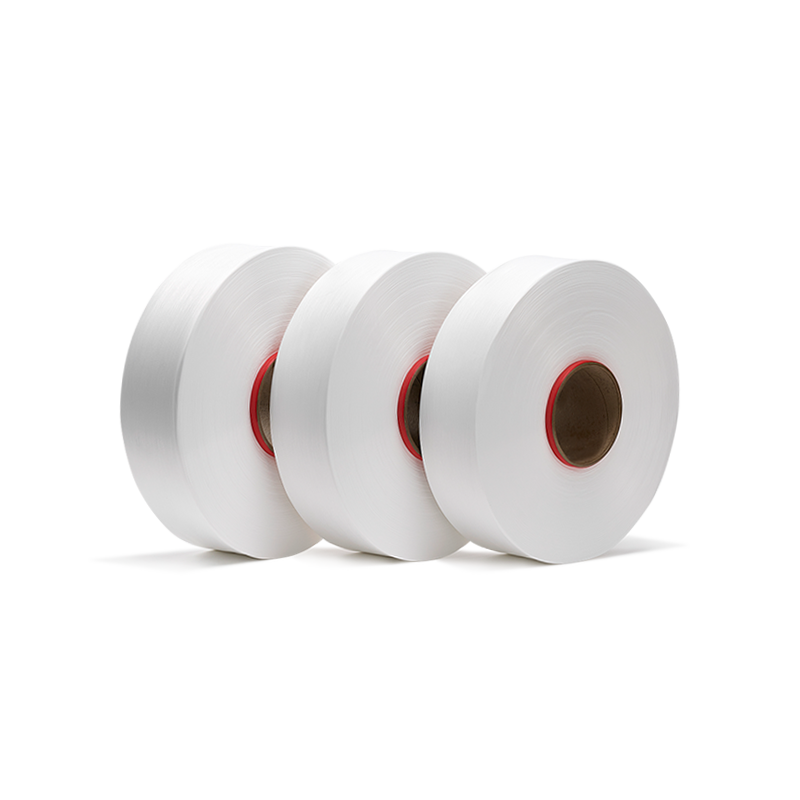 Nylon Fully Drawn Yarn (FDY)This highly oriented, smooth nylon yarn offers low shrinkage and stable tension on the loom, making it a dependable warp for plain and satin weaves where dimensional accuracy and clean luster matter most.View Product →
DTY: bulk and body where the cloth needs it
Draw textured yarn is false-twist textured after drawing, so it carries crimp, bulk, and mild stretch. Placed in the weft, that bulk fills out plain weaves and rounds off twill ribs, softening hand feel and reducing rigid stress points. Deciding which surface the fabric presents—smooth FDY face or textured DTY fill—is one of the most consequential calls in nylon fabric development, and our comparison of nylon DTY versus nylon FDY walks through that decision in detail.
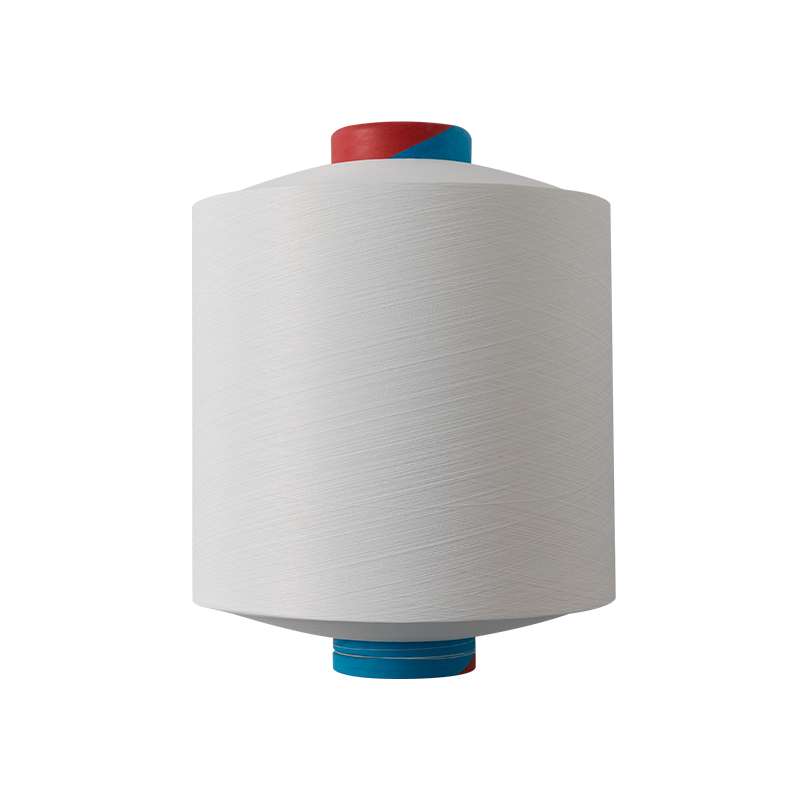 Nylon Draw Textured Yarn (DTY)False-twist texturing gives this yarn crimp, bulk, and mild stretch. As a weft yarn, it fills plain weaves and softens twill ribs, improving hand feel in activewear and children's clothing fabrics.View Product →
ACY: recovery for stretch constructions
Air covered yarn wraps nylon filaments around an elastane core in an air jet, producing one workable yarn with genuine recovery. When a construction has to flex and return—comfort waistbands, fitted shells—covering yarn lets even a firm plain weave stretch without staying deformed. Between these options sit POY, the partially oriented feedstock for drawing and texturing, and HOY, high-oriented yarn fine enough to weave directly into soft, lightweight fabrics.
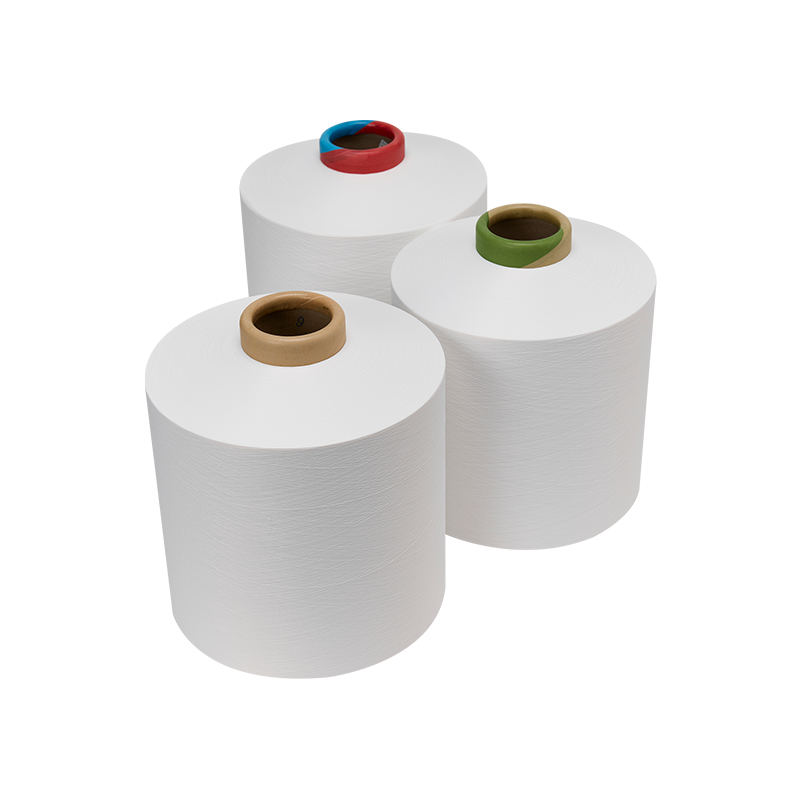 Nylon Air Covered YarnWrapping nylon filaments around an elastane core yields a single yarn with genuine recovery. It lets even firm plain weaves stretch comfortably, suiting waistbands, fitted shells, and other flexible garments.View Product →
Specifying Weave and Yarn on the Same Page
Fabric problems blamed on the loom are often specification problems. Four practices keep weave and yarn aligned from sampling through bulk production:
- Put the weave and the yarn on one line: plain weave, 70D/24F nylon 6 FDY warp x 70D/48F DTY weft, 190 gsm greige. A request for "nylon twill" leaves both sides guessing.
- Separate greige data from finished data—ends and picks per centimeter plus finished weight—because dyeing, heat setting, and coating move all three.
- Test for the structure's known failure mode: snagging on satin faces, tear propagation on plain weaves, seam slippage wherever floats run long.
- Check consistency at the yarn level first. Shade drift between dye lots usually traces to polymer and spinning conditions rather than the weaving shed, which is why reviewing a supplier's nylon 6 chips grades and applications belongs in fabric development, not just resin purchasing.
Weave sets the architecture of a fabric; yarn sets the ceiling of what that architecture can achieve. Specifying both together—plain, twill, or satin on one side of the line, chips grade and filament type on the other—produces quotes that are actually comparable, trials that predict bulk production, and cloth that repeats from lot to lot. A nylon 6 manufacturer such as Fangyuan New Material, which controls the chain from chips through POY, HOY, FDY, DTY, and ACY, can support that level of detail, because the team answering your yarn questions also understands how those yarns behave at speed on the loom.